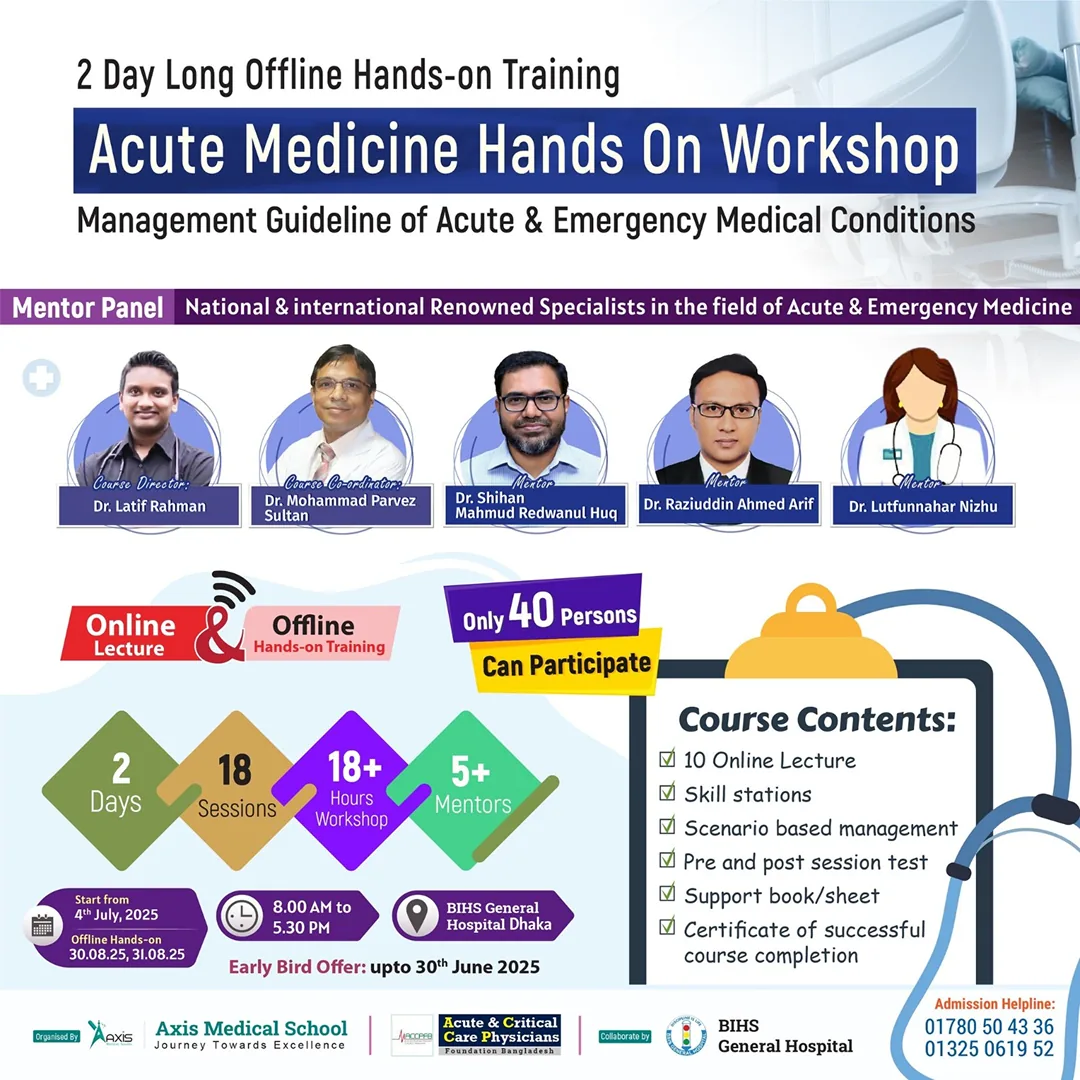
Acute Medicine Long Courses

Introduction
It is almost an everyday practice for hospital physicians in Bangladesh to deal with patients with acute medical conditions.
The junior medical doctors(who often have to manage such patients as front line physicians) need robust support to equip them with the necessary knowledge and skills regarding how to manage such patients with acute medical conditions based on the resources they have locally.
The international textbooks and guidelines often do not reflect the resources available locally to these doctors.
Hence, it is of vital importance to design a course by which these doctors would be equipped with the knowledge and skills to manage such patients with the resources available to them.
Prerequisite to enroll in the program
This program is open to all frontline doctors in Bangladesh.
Intended learning outcomes
Upon completing this course participants will be able to:
- Demonstrate a profound understanding of the principles of overall management of various common acute medical conditions which they will have to deal with in their everyday practice
- Demonstrate proficiency in the diagnosis of the above discussed acute medical conditions
- Demonstrate the knowledge, skillsets and confidence required in the treatment of the above discussed acute medical conditions
- Demonstrate proficiency in managing the above discussed acute medical conditions in a safe manner using resources available locally to them.
- Develop the professionalism required to become the ‘ideal doctor’
Content and Structure
Indicative Duration of the course: 6-7 months
To achieve the outcomes the theoretical components of the will be delivered through weekly online teaching sessions over zoom/MS teams. Each session will be 60-90 minutes long and delivered by a doctor at post graduate level. The hands on sessions will be held through whole-day workshops.
The below is a list of the topics which will be taught in this course:
Theoretical Clinical Sessions:
Basics of Resuscitating an Acutely Unwell Medical Patient(approx number of sessions required: 3)
- ABCDE assessment and management
- Haemodynamic Instability
- Principles of Oxygenation and management of respiratory failure
- Anaphylaxis
Cardiovascular (indicative number of sessions required: 3)
- Chest pain
- Palpitations
- Syncope/Transient loss of consciousness
- Acute coronary syndrome
- Arrythmias
- Acute Pulmonary Oedema
- ECG
Respiratory (indicative number of sessions required: 3)
- Breathlessness
- Cough and hemoptysis
- Pneumonia
- Acute Exacerbation of COPD/Asthma
- Pulmonary embolism
- Pneumothorax and chest drain management
- Chest radiology
Gastroenterology (indicative number of sessions required: 3)
- Diarrhea
- Vomiting
- Abdominal Pain
- Jaundice
- Upper GI Bleed
- Deranged LFTs
- Acute Liver failure, Decompensated Chronic Liver Disease, Acute on Chronic Liver Failure
- Inflammatory bowel disease
- Acute Pancreatitis
Neurology (indicative number of sessions required: 3)
- Unconsciousness
- Delirium
- Seizures and status epilepticus
- Limb weakness
- Headache
- Dizziness and vertigo
- Stroke
- Menino-encephalitis
- Subarachnoid Haemorrhage
- GBS
- Cauda equina syndrome and cord compression
- Neuro-radiology
Endocrinology and metabolic disorders(indicative number of sessions required: 3)
- Interpretation of Arterial Blood gas analysis(ABG) reports
- Hypo and hypernatremia
- Hypo and hyperkalemia
- Hypo and hypercalcemia
- Acute kidney injury
- DKA and HHS
- Adrenal crisis and thyrotoxicosis
Hematology (indicative number of sessions required: 2)
- Bleeding patient and major haemorrhage
- Deep vein thrombosis
- Haaematological malignancies at the front door
- Thrombocytopenia and thrombotic pathologies
Infectious diseases (indicative number of sessions required: 2)
- Sepsis
- COVID 19
- Malaria
- Enteric Fever
- Tuberculosis
- Dengue
- Antibiotics
Toxicology (2 sessions)
- General Toxicology and Toxidromes
- Paracetamol poisoning
- OPC poisoning
- Corrosive poisoning
- Aluminium phosphide poisoning
- TCA Overdose
- Neuroleptic malignant syndrome, serotonin syndrome
Practical Hands-on Workshops(these will be covered over a duration of 2 full days)
Practical Sessions:
- Airway Management: Basics and Advanced (indicative time: 1 hour)
- Basics of Ventilation: non invasive and invasive (indicative time: 1 hour)
- Basics of BLS and ALS (indicative time: 3 hours)
- Basics of Point of Care Ultrasound and Echo (indicative time: 3 hours)
- Chest Drain and its management (indicative time: 1 hour)
- Lumbar Puncture (indicative time: 1 hour)
- CV line (indicative time: 1 hour)
- Ascitic Tap and Drain (indicative time: 1 hour)
- DC cardioversion (indicative time: 1 hour)
Blended learning methods will be used in the course by using a social media group (Facebook or Wats app). This will be done with the purpose of creating the opportunity for asynchronous learning in between sessions where the participants will be encouraged to discuss any cases or encounters where they applied the theoretical knowledge learned during the sessions. This will also give the participants a chance to clarify any doubts they may have when applying the knowledge.
Teachers will be encouraged to use flipped method of learning by providing reading materials before the teaching sessions to increase engagement during the classrooms and encourage problem-solving.
Feedback from the participants will be encouraged throughout the course and this will be used to target and improve teaching delivery and content.
Summary of the Structure of teaching course
Duration of the course: approx. 6-7 months
Number of theoretical sessions: approx.. 24 sessions
2 days of Practical hands on workshop
Medium of instruction:
a. Weekly online teaching sessions each lasting 60-90 minutes
- Blended learning for asynchronous learning activities using a social media platform(facebook/whats app)
- Hands-on workshops
Assessments:
There will be period assessments held throughout the course. This will be in the form of:
- MCQ exams at regular intervals: pass mark 60%(there will be an option to re-sit if candidates fail in the first attempt)
- Each participant should submit 5 case reflections at the end of the course highlighting encounters where they applied learned knowledge from the course.
Conditions to remain enrolled and getting certified
- Maintaining 50% attendance across the course
- Attending all the MCQ exams held across the course and passing them.
- Attending all the practical hands on workshops
- Submitting the 5 case reflections at the end.
The above will be enforced strictly and anyone who will not maintain the above requirements will not receive certificate from this course.