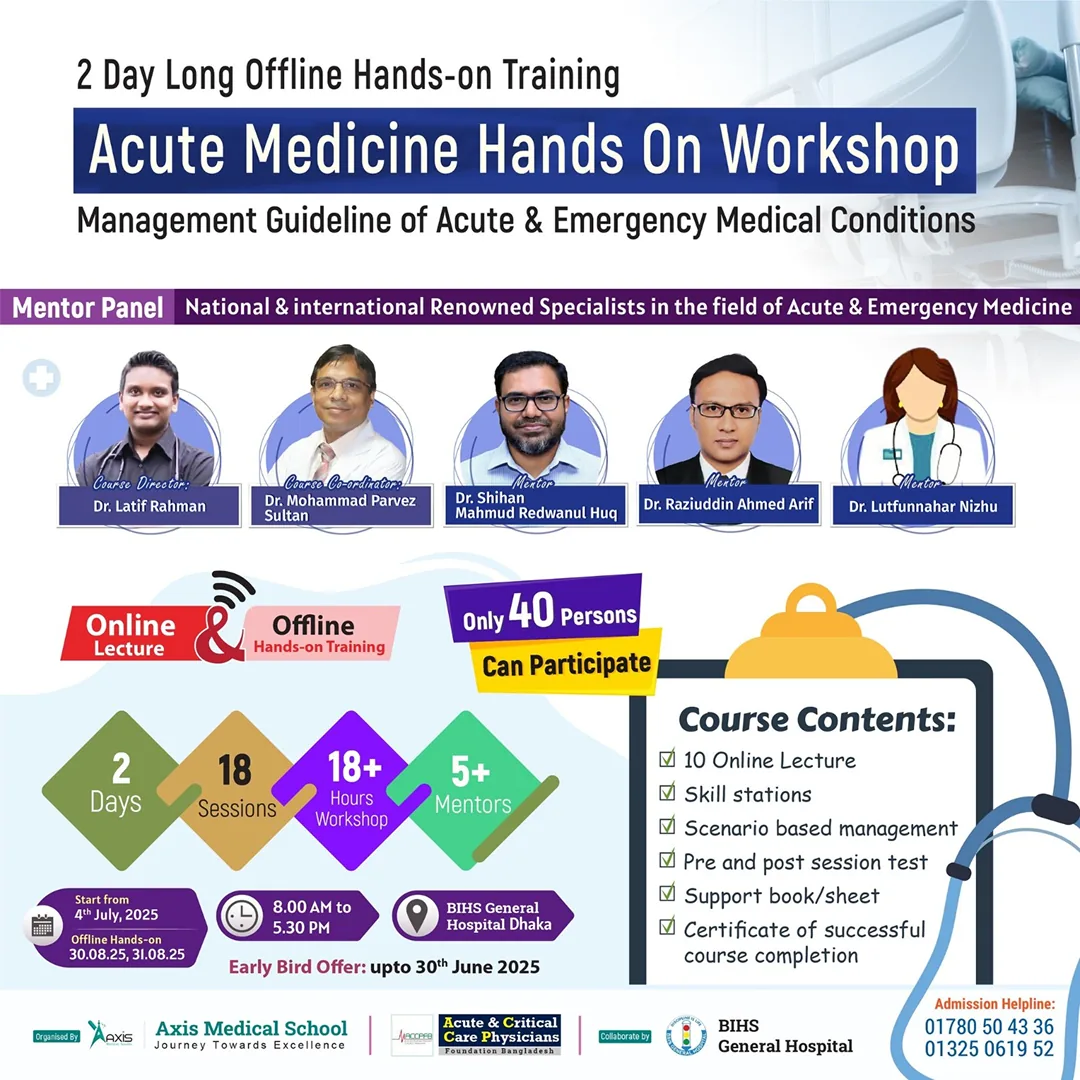
Acute Medicine Short Courses

Introduction
It is almost an everyday practice for hospital physicians in Bangladesh to deal with patients with acute medical conditions.
The junior medical doctors(who often have to manage such patients as front line physicians) need robust support to equip them with the necessary knowledge and skills regarding how to manage such patients with acute medical conditions based on the resources they have locally.
The international textbooks and guidelines often do not reflect the resources available locally to these doctors.
Hence, it is of vital importance to design a course by which these doctors would be equipped with the knowledge and skills to manage such patients with the resources available to them.
Prerequisite to enroll in the program
This program is open to all frontline doctors in Bangladesh.
Intended learning outcomes
Upon completing this course participants will be able to:
- Demonstrate a profound understanding of the principles of overall management of various common acute medical conditions which they will have to deal with in their everyday practice
- Demonstrate proficiency in the diagnosis of the above discussed acute medical conditions
- Demonstrate the knowledge, skillsets and confidence required in the treatment of the above discussed acute medical conditions
- Demonstrate proficiency in managing the above discussed acute medical conditions in a safe manner using resources available locally to them.
- Develop the professionalism required to become the ‘ideal doctor’
Content and Structure
Indicative Duration of the course: 8 theoretical classes over 2 months followed by 2 full days of practical training
As detailed later, this course will follow a flipped learning method and blended learning method of teaching whereby the participants will be supported through a range of relevant resources shared with them before the course.
The below is a list of the topics which will be taught in this course:
Theoretical Clinical Sessions:
Basics of Resuscitating an Acutely Unwell Medical Patient (indicative time: 2 hours)
- ABCDE assessment and management
- Haemodynamic Instability
- Principles of Oxygenation and management of respiratory failure
- Anaphylaxis
Cardiovascular (indicative time: 2 hours)
- Chest Pain
- Acute Coronary Syndrome
- Acute Pulmonary Oedema and Acute Heart Failure
- Arrhythmias
Respiratory (indicative time: 2 hours)
- Pneumonia
- Acute Exacerbation of COPD/Asthma
- Pulmonary embolism
- Pneumothorax
- Chest radiology
Gastroenterology (indicative time: 2 hours)
- Upper GI bleeding
- Deranged LFTs, acute liver failure, acute on chronic liver failure
- Inflammatory Bowel disease
Neurology (indicative time required: 2 hours)
- Unconsciousness
- Seizures and status epilepticus
- Limb weakness
- Neuromuscular weakness
- Headache
- Dizziness and vertigo
- Stroke
- Menino-encephalitis
- Neuro-radiology
Endocrinology and metabolic disorders(indicative time: 2 hours)
- Interpretation of Arterial Blood gas analysis(ABG) reports
- AKI
- Electrolyte imbalances
- Endocrine Emergencies
Hematology (indicative time: 2 hours)
- Bleeding patient and major haemorrhage
- Management of the anaemic patient
- Blood Transfusion Reactions
- Approach to thrombocytopenia
- Haematological malignancies at the front door
Infectious diseases (indicative time: 2 hours)
- Sepsis
- Antibiotics
- Malaria
- Covid 19
- Dengue
- Enteric Fever
- Leptospirosis
- Tuberculosis
Toxicology (indicative time: 2 hours)
- General Toxicology and Toxidromes
- Paracetamol poisoning
- OPC poisoning
- Corrosive poisoning
- Aluminium phosphide poisoning
- TCA Overdose
- Neuroleptic malignant syndrome, serotonin syndrome
Practical Sessions:
- Airway Management: Basics and Advanced (indicative time: 1 hour)
- Basics of Ventilation and oxygenation : oxygen devices, niv, high flow, cpap(indicative time: 1 hour)
- Basics of BLS and ALS (indicative time: 2 hours)
- Basics of Point of Care Ultrasound and Echo (indicative time: 2 hours)
- Chest Drain and its management (indicative time: 1 hour)
- Lumbar Puncture (indicative time: 1 hour)
- CV line (indicative time: 1 hour)
- Ascitic Tap and Drain (indicative time: 1 hour)
- DC cardioversion (indicative time: 1 hour)
The provisional schedule of the programme can be accessed by clicking the link below(please note that this may be subjected to change, but any change in schedule will be notified to the course participants with adequate notice)
Blended learning methods will be used in the course by using a social media group (Facebook or Wats app). This will be done with the purpose of creating the opportunity for asynchronous learning ahead and after the course where the participants will also be encouraged to discuss any cases or encounters where they applied the theoretical knowledge learned during the sessions. This will also give the participants a chance to clarify any doubts they may have when applying the knowledge.
The course will also employ the flipped method of learning by providing reading materials before the teaching sessions to increase engagement during the classrooms and encourage problem-solving.
Feedback from the participants will be encouraged throughout the course and this will be used to target and improve teaching delivery and content.
Summary of the Structure of teaching course
Duration of the course: 8 theoretical classes over 2 months followed by 2 full days of practical training
Number of theoretical sessions: 8
Number of practical sessions: 2 full days
Medium of instruction:
- Live Classroom teaching
- Practical hands on training
- Online based learning employing blended learning and flipped learning